
What We Will and Won't Tell You About Supplements
There is a version of this page that would make us more money.
It looks like every other supplement page in women's health: a list of conditions, four or five products under each, a paragraph explaining what each one does for your hormones, and a buy link. We could have written it in an afternoon. Most of our competitors have.
We're not going to, and the reason is the same reason we don't program your training by calendar phase.
The problem with supplement content
Nobody selling you a supplement is a neutral party. That includes us — we're a Thorne affiliate, and we earn a commission when you buy through our links. We'll come back to that.
But the deeper problem isn't the commission. It's that the person writing the recommendation almost never has the two things that would make it a real recommendation: your bloodwork, and your medication list.
Take iron. Iron deficiency is genuinely common in menstruating women, and low iron is one of the most under-recognised causes of training fatigue. All true. But iron is also a mineral your body has no mechanism to excrete. Supplementing it without knowing your ferritin isn't cautious — it's a coin flip, and one side of the flip is iron overload. Any page that recommends iron to a woman it has never tested is not giving advice. It's guessing, with a link.
The same logic applies to anything with a drug interaction, anything taken during pregnancy, and anything aimed at a diagnosed condition. Those are the exact categories where generic advice does the most damage, and they're the categories the supplement industry markets hardest.
So here's our line.
What we won't do
We won't tell you what to take for your condition. Not for PMOS (formerly PCOS), not for endometriosis, not for perimenopause. Deciding what a specific woman with a specific diagnosis and a specific medication list should be supplementing is clinical work. We don't have your labs, and we're not your clinician.
We won't recommend supplements during pregnancy or breastfeeding. Prenatal nutrition is managed by your OB or midwife. There is no version of us taking a commission on that which we'd be comfortable explaining.
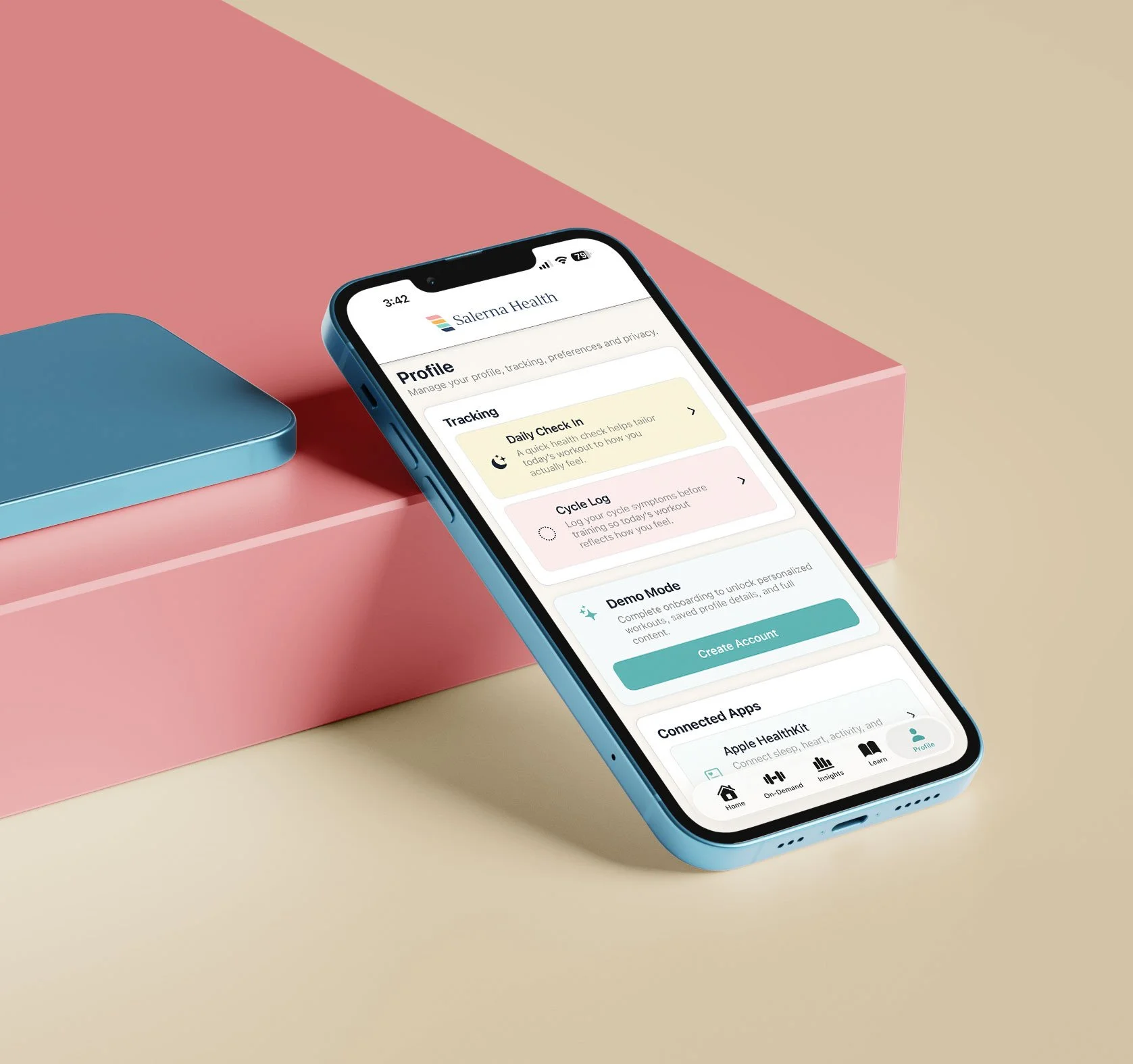
We won't build a supplement recommendation into your daily programming. Your session adapts to what you report. It doesn't upsell.
We won't make claims we can't stand behind. No hormonal balance, no ovulatory function, no insulin optimisation. If a sentence would need a clinical trial to justify it, it doesn't go on our site.
What we will do
We'll tell you how to check that a supplement contains what the label says, and nothing it doesn't. That's a verifiable question with a verifiable answer, and it's the one part of this that doesn't require knowing anything about your body.
It matters more than most people realise. Dietary supplements in the US aren't approved by the FDA before sale. Manufacturers are responsible for their own quality control, and enforcement is after the fact. Independent testing has repeatedly turned up products that under-deliver the labelled dose, over-deliver it, or contain compounds that never appeared on the label at all. For a woman managing a condition — or anyone subject to drug testing — that isn't a technicality.
Third-party certification is the check. The two that mean something in this category:
NSF Certified for Sport® — verifies label accuracy and screens for over 280 substances banned in sport. Used by major professional leagues. Certification is granted per product and per batch, not to a company as a whole, so the question is always whether the specific product in your hand carries the mark.
Informed Sport — a comparable batch-testing programme, also widely used in professional sport.
Neither certification tells you a supplement works. Both tell you it is what it claims to be. That's the distinction the industry blurs and we won't.
Why we point people to Thorne
Three things, stated at the size they actually are:
Thorne carries one of the larger ranges of NSF Certified for Sport products. Not the entire catalogue — no manufacturer's whole line is certified, because certification is per-product. Check the mark on the specific item you're buying. Thorne lists its certified products separately, which makes that easy.
Thorne is widely stocked by clinicians. It's a brand that shows up in practitioner dispensaries rather than one built on retail marketing. That's a signal about distribution and quality positioning. It is not evidence that any given product does what you want it to do.
Thorne has run research collaborations with Mayo Clinic. Real, and worth knowing. Also worth knowing: the published work from that collaboration is narrow and unrelated to women's hormonal health — the most cited output studied brain function in junior ice hockey players. We mention the collaboration because it's true and because people ask. We're not going to pretend it validates anything for you specifically.
That's the whole case. It's a sourcing recommendation, not a health recommendation.
The three questions worth asking before you take anything
1. Have I been tested?
For iron, vitamin D, and B12 in particular, a blood test converts a guess into a decision. Ask your clinician. Most of these are routine and inexpensive.
2. Does this interact with what I'm already taking?
This is not a small category. Botanicals and high-dose nutrients interact with hormonal contraceptives, thyroid medication, anticoagulants, metformin, and GLP-1 receptor agonists among others. Your pharmacist will answer this for free, quickly, and better than any website.
3. Is this doing a job that food is already doing?
Protein is the clearest example. If you're training for strength — and especially if you're on a GLP-1 medication, where reduced intake makes protein harder to hit — total daily protein matters a great deal. Whether it arrives as food or powder is a convenience question, not a physiological one. Powder is a tool for hitting a target, not a supplement in the interesting sense.
If a product survives all three questions, buy the version that carries a third-party certification mark. That's the point at which we're useful.
Transparency
Salerna is a Thorne affiliate. If you buy through our links, we earn a commission at no additional cost to you. We've told you that before the links rather than after them, which is the order we'd want it in if we were reading.
Thorne has no editorial control over anything on this page and did not review it before publication. We're not paid to write specific claims, and you'll notice we haven't made any.
Our position on supplements is the same as our position on your training data: we'd rather tell you what we don't know than sell you certainty we haven't earned.
Frequently Asked Questions
Does Salerna sell supplements?
No. We're a Thorne affiliate. If you buy through our links you're buying directly from Thorne, and we earn a commission at no extra cost to you.
Why don't you recommend specific supplements for my condition?
Because we don't have your bloodwork or your medication list, and both are required to answer that question responsibly. Supplement decisions for a diagnosed condition belong with your clinician. We'll help you evaluate product quality once you know what you're looking for.
Do you recommend supplements during pregnancy or breastfeeding?
No. Prenatal and postpartum nutrition is managed by your OB, midwife, or a registered dietitian. We won't take a commission on that decision.
What does NSF Certified for Sport actually verify?
That the product contains what the label says, in the amounts stated, and that it's been screened for over 280 substances banned in sport. Certification is per product and per batch. It verifies contents and purity — it is not evidence that a supplement produces any particular effect.
Is any of this medical advice?
No. Nothing here is medical advice, and nothing here is a recommendation to take any specific supplement. Talk to your healthcare provider or pharmacist before starting anything, particularly if you're pregnant, breastfeeding, taking prescription medication, or managing a diagnosed condition.
Does Salerna's training programme change based on what I supplement?
No. Your session adapts to what you report in your daily check-in — sleep, energy, symptoms, recovery. Supplements are not an input to the prescription and never will be.
